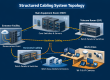
Open the network closet in many businesses and you find a tangle: cables of every color, unlabeled ports, and nobody who remembers what connects to what. It works until something breaks, and then every minute of guessing costs money. A well-organized closet is cheaper to maintain, easier to fix, and safer to change. Here is what “organized” means in practice.
What a Patch Panel Does
The cables that run through your walls to wall jacks end at the back of a patch panel in the network closet. Short patch cables then connect each port on the panel to a port on a network switch. The permanent cabling stays untouched, and all changes happen with the short cables at the front.
This protects the cables in the walls from repeated handling, makes moves and changes quick, and keeps the closet readable. Connecting wall cables directly to switches is a shortcut that creates problems later.
Labeling That Actually Helps
- Label both ends of every cable with the same unique ID: the wall jack and the patch panel port.
- Use a clear, consistent scheme, such as room or area plus a number, so anyone can understand it.
- Use printed, durable labels, not handwriting or tape that peels off.
- Label patch cables and equipment too, including switches, power supplies, and the internet connection.
- Keep a matching spreadsheet or diagram showing what each jack serves, such as a desk, printer, camera, or access point.
- Update labels when things change. A wrong label is worse than no label.
What a Tidy Closet Looks Like
- Equipment mounted in a rack or cabinet, not stacked on a shelf or on the floor.
- Cable management bars and ties so cables run neatly and are not pulled tight or bent sharply.
- Patch cables of the right length, not long loops stuffed behind the equipment.
- Color-coding by purpose, such as one color for phones and another for cameras, if that suits you.
- Power and data cable kept separate, and equipment on battery backup. See UPS battery backup.
- Good airflow and cooling, and a locked door. See our network closet checklist.
- Free space for growth.
The Business Case
- Faster repairs: a technician can find the right cable in minutes instead of tracing it by hand.
- Fewer accidental outages: people unplug the wrong cable when nothing is labeled.
- Lower support costs: time spent figuring things out is time you pay for.
- Easier moves and upgrades: changes take less time and carry less risk.
- Better security: you can tell when something is plugged in that should not be. See signs your network needs a security review.
Test and Document the Work
Organization goes hand in hand with proof that the cabling works. See cable testing and certification, and if your cabling is older, whether to replace it. For new projects, build labeling and documentation into the plan from the start. See our low-voltage planning checklist.
Is Your Network Closet a Mess?
Scio Info Tech cleans up, labels, and documents network rooms for businesses across California. Tell us what you have and we will quote a tidy-up that pays for itself.