
When you plan a new office, a remodel, or a network upgrade, one of the first questions is: which cable should we install? The three most common answers are Cat6, Cat6A, and fiber optic. Each has real strengths, and the right choice depends on your building, your equipment, and how much growth you expect.
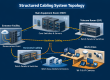
This guide explains the differences in plain language. If you are new to the topic, start with our overview of what structured cabling is and why your business needs it.

The Short Answer
- Cat6 is a solid, cost-effective choice for typical office desks and devices that run at gigabit speeds.
- Cat6A is the best choice for most new installations, especially for Wi-Fi access points, PoE devices, and anyone who wants to be ready for 10 Gigabit.
- Fiber optic is the right choice for links between rooms, floors, and buildings, and for very high speeds or long distances.
Most well-designed networks use both: fiber as the backbone and Cat6 or Cat6A to reach desks, phones, cameras, and access points.
Cat6: The Reliable Workhorse
Category 6 (Cat6) copper cable supports gigabit Ethernet over the full 100-meter channel length and can carry 10 Gigabit over shorter distances (roughly 37 to 55 meters, depending on conditions). It is thinner and more flexible than Cat6A, so it is easier and usually cheaper to install.
Best for: standard office workstations, phones, printers, and general use where gigabit speeds are enough and budget matters.
Watch out for: limited headroom. If you expect to move to 10 Gigabit, add many high-speed Wi-Fi access points, or run long cable lengths, Cat6 may become a limit sooner than you expect.
Cat6A: Built for the Next Decade
Category 6A (the “A” stands for augmented) supports 10 Gigabit Ethernet over the full 100 meters and is designed to handle more interference from neighboring cables. It performs at higher frequencies than Cat6, which gives your network more room to grow.
The tradeoff is physical: Cat6A cable is thicker and stiffer, needs larger conduit and cable trays, and takes more care to install. Materials and labor typically cost more than Cat6.
Best for: new construction, Wi-Fi 6 and Wi-Fi 7 access points, PoE cameras and devices, server and equipment rooms, and any business that wants to install cable once and not revisit it for many years.

Why Wi-Fi Makes Cabling Matter More
Many people assume wireless means cabling no longer matters. The opposite is true. Every Wi-Fi access point is connected to your network by a cable, and modern access points can move more data than a single gigabit cable can carry. Running Cat6A to each access point means your wireless network will not be held back by the wire behind it.
The same cable can also deliver power through Power over Ethernet (PoE), so there is no need for an electrical outlet in the ceiling. Higher-power PoE standards generate heat inside cables, and good quality Cat6A handles that better in large bundles.
Fiber Optic: Distance, Speed, and Isolation

Fiber optic cable carries data as pulses of light through thin strands of glass. That gives it several advantages over copper:
- Distance: multimode fiber commonly reaches hundreds of meters at 10 Gigabit, and single-mode fiber can reach many kilometers.
- Speed capacity: fiber easily supports 10, 25, 40, and 100 Gigabit links, so it is the standard for backbones and server connections.
- No electrical interference: light is not affected by motors, lighting, or power cables.
- Electrical isolation: fiber does not conduct electricity, which makes it a safe choice between buildings where ground differences or lightning could damage copper links.
Watch out for: fiber does not carry power, so devices like cameras and access points cannot be powered over it. Fiber equipment and termination also cost more, and installation needs specialized tools and training. For most desk and device connections, copper is still the practical choice.
Best for: links between floors, between buildings on a campus, to server rooms, and anywhere you need long distance or very high speed.
Side-by-Side Comparison
| Feature | Cat6 | Cat6A | Fiber optic |
|---|---|---|---|
| Typical use | Desks, phones, printers | Wi-Fi, PoE, new builds | Backbone, between buildings |
| Gigabit speeds | Yes, up to 100 m | Yes, up to 100 m | Yes |
| 10 Gigabit | Short runs only (about 37 to 55 m) | Full 100 m | Yes, long distances |
| Maximum distance | 100 m | 100 m | Hundreds of meters to many kilometers |
| Carries PoE power | Yes | Yes | No |
| Installation difficulty | Easier | More demanding (thicker cable) | Specialized |
| Relative cost | Lower | Medium | Higher for equipment |
How to Choose: Quick Guide
- Small office, tight budget, gigabit is enough: Cat6.
- New office or remodel, you want to be future-ready: Cat6A for the horizontal runs.
- Wi-Fi access points and PoE cameras: Cat6A.
- Connecting two floors, rooms far apart, or separate buildings: fiber.
- Server room or heavy data users: Cat6A to devices, fiber for uplinks between switches.
- Not sure: a site survey will answer it. The right choice depends on distances, equipment, and your plans.
What About Cat5e and Cat8?
Cat5e is the older generation. It handles gigabit speeds, but it has less headroom and we rarely recommend it for new installs. Existing Cat5e does not always need to be replaced right away, but it is worth testing.
Cat8 supports 25 and 40 Gigabit but only up to about 30 meters, so it is mostly used inside data centers. Most offices do not need it.
Don’t Forget Installation Quality
The best cable in the world will underperform if it is installed poorly. Proper termination, correct bend radius, careful routing away from power lines, and certification testing matter just as much as the cable category. Ask any installer whether they test and document every run, and request the results.
In California, cable must also meet the fire rating required for the space, for example plenum-rated cable in air-handling areas, and firestopping where cable passes through fire-rated walls and floors.
Not Sure Which Cable Fits Your Office?
Scio Info Tech designs and installs structured cabling for businesses in the San Francisco Bay Area, Sacramento, Los Angeles, and across California. Tell us about your space and we will recommend the right mix of cabling for your needs and budget.